
Hello beings of this beautiful planet. Thanks for stopping by!
We are 2 posts into the series covering the Pancha Bhoota Temples.
Haven’t read? Here are the links –
Srikalahasteeswarar Temple, in SriKalahasti
Now, let’s dive straight into Destination 2, which is the Ekambareshwar Temple in Kancheepuram/Kanchipuram.
There is a reason why Kancheepuram is famously known as the “City of a Thousand Temples.” A good 2-3 days can easily be spent in Kancheepuram, immersing oneself in everything this city has to offer. Click here for the List of Hindu Temples in Kancheepuram.
Since we had only a day to spare, and our primary focus was to visit the Pancha Bhoota temple, we chose to see 3 of the most famous temples, Ekambareshwar Temple, Kanchi Kamakshi Amman Temple, and Varadaraja Perumal Temple.
Pancha Bhoota, as explained in my previous posts, represent the fundamental meaning of life itself. Pancha Bhoota, i.e., 5 elements, manifest themselves through everything that exists on earth.
One of the largest temples in Kancheepuram, and perhaps the largest, the Ekambareshwar Temple represents the Earth element. Lord Shiva is worshipped and represented by the Shiva Lingam named Ekambareshwarar or Ekambaranathar. According to legend, Goddess Parvati created a lingam out of sand and worshipped it ardently to win over Lord Shiva.
I must admit that I am learning more about the temple in the process of writing my travel memoirs. For example, I had no idea that the temple roof has carvings of all 12 zodiac signs, offering relief from astrological defects (Parihara) for those who pray there (especially for Earth signs), or that the inner passage of the temple is covered by the 10 pillars which produce musical sound if a stick is passed over them.
An older version of me would have been a tad disappointed at having missed exploring more about this temple. The current version of me, however at peace with what we could explore. Unlike the Srikalahasti temple, where we journaled and meditated, at Kanchipuram, we just meditated.
I started to meditate in 2016, when I had reached my lowest point in life. I had chosen to ignore, even though I had people suggesting to meditate. Who wants to waste time in meditation when one can use that time doing worldly chores, right? How wrong was I! The benefits of taking time off to simply connect with oneself, through breath, chant or guided meditations or whatever calls out to you, when you begin, is better experienced. Because no written or spoken words can.
We left the hotel at about 545 am and headed to Kanchi Kamakshi Amman Temple. More about it in my future post. After praying and meditating here, we head to the Earth Temple.
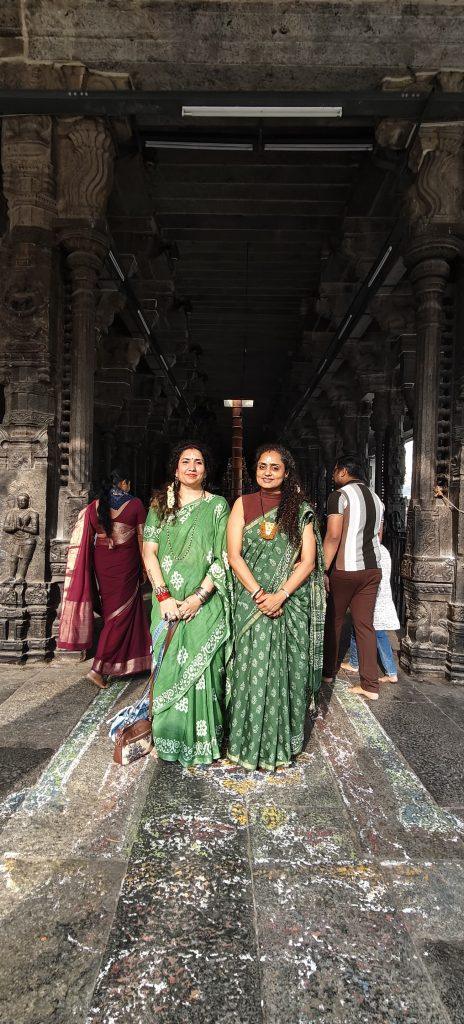
For the Ekambareshwar Temple, Shivohie & I chose to wear green. Symbolically, representing Mother Earth, in her glory, the verdant, the ever-forgiving and ever-giving Mother Nature.
At 192ft, this temple reserves its place as one of the tallest temple towers in India. The temple is situated on Ekambareswarar Sannidhi Street and is open from 6:00 a.m. to 9:00 p.m. The entry to the temple is free, and Puja can be performed here at approximately 1000 INR (the cost may vary based on the Puja being conducted).
Did you know that there are important Shiva temples aligned along the single geological meridian? It was an amazing fact to learn about. Research conducted by IIT Roorkee stated that ancient Indian civilisations may have had a deep understanding of nature and sustainability, which guided their choices of where to build major temples. Imagine! Different temples located in different geographies are being built along the 79°E meridian; all this with no technology or GPS, while using yogic and astronomical science. This alignment, stretching from the Himalayas to the southern tip of India, is considered a remarkable feat of ancient architecture and astronomy.
To our joy, we learnt the 4 of the Pancha Bhoota temples were built on the 79°E meridian. The temples situated on powerful geomagnetic or energy lines of the Earth are believed to amplify spiritual energy. The only Pancha Bhoota temple that doesn’t come on the meridian line is the Jambukeswara Temple in Thiruvanaikaval (representing the Water element).
We walked into this sprawling 40-acre land, and then into this magnificent temple, admiring the Dravidian architecture while silently chanting Om Namah Shivaya in our minds.
There is a separate shrine, Nilathingal Thundam Perumal temple, dedicated to Lord Vishnu. And the mango tree that bears 4 different types of mango still exists. This 3500-year-old mango tree is the very tree under which Goddess Parvati did her penance to win over Shiva. So the legend goes.
Kancheepuram, my birthplace, has been on my bucket list for a while. I grew up hearing my mother talking about Ekambareshwar Temple and the 68th Shankracharya. I am beyond grateful to have finally visited Kancheepuram, although I am far from done. A one-day trip doesn’t do any justice to the land of temples. Does it?
Being a popular temple, Ekambareshwar Temple attracts a big crowd of devotees throughout the day. But, nothing prepared us for what awaited us at Thiruvannamalai (Annamalaiyar) Temple, representing the Fire (Agni) element. Compared to this, our visit to Srikalahasti Temple and Ekambareshwar Temple was a cake walk.
Coming up next, Annamalaiyar Temple. Stay tuned.
Traveling inward, wandering outward.
With travel stories that go deeper than what meets the eye
Priyaa
p.s: Trip to Kancheepuram cannot officially end until you visit a Kanchipuram sari shop. We luckily had some time to experience a local sari shop. God bless the security chap at the hotel who gave us 2 names, and somehow the name A.S. Babu Sah stuck in our head. There are quite a few fake shops with similar-sounding names, and one must observe utter caution and visit the OG shop at Naidu Street. Though they were in the process of moving to a new location when we visited. They have a small food area for the serious shoppers to replenish in between the shopping fervour. They can courier the saris to your home, too.


