
Hello beings of this beautiful planet. Thanks for stopping by!
The intention behind action primes us to stay conscious and advance in life in an awakened state. So, for the Pancha Bhoota trip, we decided to make sense (in our head) of the geographic route (shared in the last post), and set intentions before visiting the temple. Before diving into the itinerary, here’s what we discussed between ourselves. (You have the freewill to skip this part and dive right into the itinerary if you’d like.)
Our Intentions for:
Destination 1: Srikalahasteeswarar Temple, in SriKalahasti, to cleanse our prana, the life force that helps us exist on the physical plane. Basically, a deep cleanse before inviting the new.
Destination 2: Ekambareshwar Temple, in Kancheepuram, to pray for clarity to walk through life in this physical body (our ego self). To integrate qualities such as grounding, discipline, and balance. Marry spirit and matter.
Destination 3: Arunachaleswarar Temple, in Tiruvannamalai, to go through the fire of transformation. Letting go of anything that is holding us back in realising our true potential. To let go of ego, anger, fear, and the lower energies, and to make space for the new, higher vibrational energies like love, humility, kindness, compassion, and balanced motivation to flow through life as we perform our dharmas.
Destination 4: Thillai Nataraja Temple, in Chidambaram, to connect with all that is. To feel the expansion within ourselves. To learn to witness life with awareness. To tap into the “self”, the inner knowing, that is just there, not identifying with the external. Be spiritually autonomous.
Destination 5: Jambukeswarar Temple, in Tiruvanaikkaval, to connect with our emotions with an awareness. Not suppress or escape, just witness the emerging emotion in us. To joyfully go with the flow of life through surrender, gratitude, and invite emotional harmony.
Please note, in no way am I suggesting that with just setting an intention, miracles can happen. Acting on the inner nudges, no matter how painful it is, is an important step to follow for any transformation to occur. Although miracles happen. As one of my spiritual teachers said, “Expect nothing, while expecting everything.”
With that, let’s dive into Destination number 1.
Srikalahasteeswarar Temple, in Sri Kalahasti
After picking up Shivohie from the Chennai airport, we head straight to Srikalahasteeswarar Temple, aka Sri Kalahasti, located in Tirupati District, Andhra Pradesh, on the banks of the Swarnamukhi River. It took us about 3 hrs with no break to get there.
One good thing about most of these temples is that they are open mostly throughout the day, except for a short lunch break. The temple is open from 5:30 am until 9 pm.
Dedicated to Lord Shiva as Kalahasteeswara and Goddess Parvati as Gnana Prasunambika Devi, Srikalahasti is one of the Pancha Bhoota Stalams (five elemental shrines of Shiva), representing Vayu (Air). It is a self-manifested (Swayambhu) Lingam, not sculpted by human hands, and is said to emit a continuous natural breeze within the sanctum. As per the legend, the God of Air performed penance here and was blessed by Lord Shiva to remain as the Vayu Lingam forever.
Goddess Gnana Prasunambika Devi’s shrine is located to the left of the main sanctum. Her name symbolises “the flower of wisdom and knowledge.” She is worshipped for removing ignorance and gaining clarity, enlightenment, prosperity, and harmony.
But of course, there is Nandi, the sacred bull and loyal devotee of Shiva, in front of the sanctum, in every Shiva temple. I can’t recall where I heard or read this, on a lighter note, that Nandi reminds us to keep our “bull” out before entering the temple, to earnestly begin our journey from worldly life to spiritual liberation.
Sri Kalahasti temple is known as Dakshina Kailasam, “Kailasa of the South.” As per the ancient scripture, the air flowing through the sanctum is said to be the same divine breath that originates from Kailash. Here lies a history that stretches back more than a thousand years.
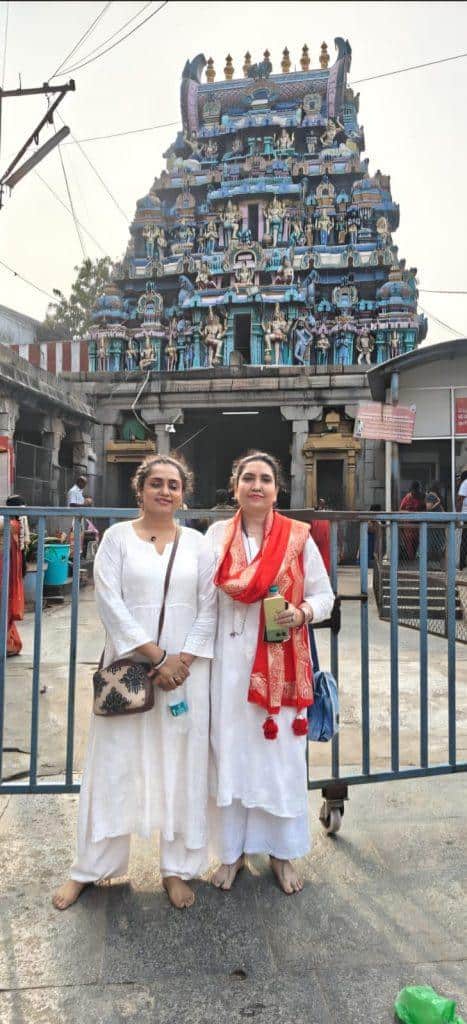
Modest dressing is advisable in the temple. Shivohie and I had pre-planned colours of our attire congruent to the elements (temples) we were visiting. We were dressed in white at Sir Kalahasti temple, symbolising our desire for clarity, in our thoughts (air).
Air represents dynamics on the level of our thoughts, intellect and mind. Pure air, which circulates freely and harmoniously, symbolizes positive, kind, well-intentioned, altruistic, luminous thoughts that allow us to elevate our conscience and commune with the Divine. Source: Kaya. Dictionary, Dreams-Signs-Symbols.
Before we entered the shrine, we visited a small temple dedicated to the legendary tribal hunter and leader, Kannappa. Kannappa Mythology tells the story of Kannappa Nayanar, a tribal hunter who became one of Lord Shiva’s greatest devotees by demonstrating ultimate selfless love, famously offering his own eyes to stop the bleeding of a Shiva Lingam at Sri Kalahasti, proving pure devotion surpasses rituals and scriptures, leading Lord Shiva to appear, restore his sight, and grant him liberation. I had watched the movie Kanappa on OTT months before my trip, which gave me a deeper understanding of the visit to Kannappa’s shrine.
And that’s not the only legend connected with this temple. It is believed that Lord Shiva himself appeared here to bless three creatures – a spider (Sri), serpent (Kala), and elephant (Hasti) – for their unwavering devotion. Hence the temple name. Know more about the mythological significance.
We picked up Puja items and entered the shrine of Sri Kalahasti, and to connect with Lord Shiva, representing the Air element.
Entry to the temple
Entry to the temple is free, with options for paid special darshan. Since we were time-bound, we chose the latter option and bought tickets for 200 INR per person. There was a 500 INR ticket available as well, which would take you closer to the sanctum sanctorum (garbh grah); however, only UPI was accepted for this option. No one told us that as we submitted our mobile phones at the counter outside the temple premises. Yeah, that was a duh moment! A communication disconnect right under the deity’s nose! Hehe.
Point to be noted: Since we had already decided to accept what comes, there was no intense emotion felt in that moment.
The uniqueness of this temple is the miraculous, continuously flickering oil lamp within the closed sanctum, symbolizing the living breath of Lord Shiva.
After visiting the sanctum sanctorum, we chose an empty spot, which we were lucky to find in the temple teeming with devotees/believers. The empty spot was to sit and meditate. We even did some letter writing (read: journaling), secretly hoping to get a direct connection with God. Haha! Jokes apart, journaling helps us bring out our deepest fears and desires. It raises self-awareness and helps identify the challenges and gain clarity about ourselves.
Sri Kalahasti temple is also famous for the Rahu-Ketu Pooja that can be booked and performed here. The charges are 5k INR. The Puja is believed to remove graha doshas and planetary obstacles that can show up in one’s life in the form of obstacles, mental stress, financial issues, and karmic challenges
Step-by-Step Online Booking Process
Follow these simple steps to book your tickets online:
- Visit the official website: Open www.srikalahastitemple.org.in.
- Choose your service: Select Darshan, Rahu Ketu Pooja, or Seva Booking from the menu.
- Select the date and time: The system will show available slots.
- Enter devotee details: Name, ID proof number, age, and contact information.
- Upload ID proof: Aadhaar Card or any valid government ID is required.
- Make the payment: Use a debit card, a credit card, UPI, or net banking.
- Get the confirmation: You’ll receive a ticket receipt via email/SMS.
- Download and print: Carry a printed or digital copy when you visit the temple.
Source – Sri Kalahasti Temple
Fun fact: Even with our eyes closed, Shivohie and I, could sense the eyes of people on us, as we meditated. I can’t blame them. Imagine two curly-haired ladies, dressed in white, with vibhuti smeared on the forehead, sitting and meditating and later journaling. I guess that’s not something you see every day.
As we sat there, we immersed ourselves in the Dravidian architecture of the temple, built using sandstone and granite. Spread over 2 acres, it was built by Pallavas, Cholas, and Vijayanagara Kings, the inner sanctum carved directly from a monolithic rock hill. My eyes went straight to the demon faces on the top. The “demon” on temple pillars in Indian architecture usually refers to a protective monster face warding off evil, symbolizing impermanence and self-consumption. Reminded me of a video I had watched about Yali, the Mythological beast.
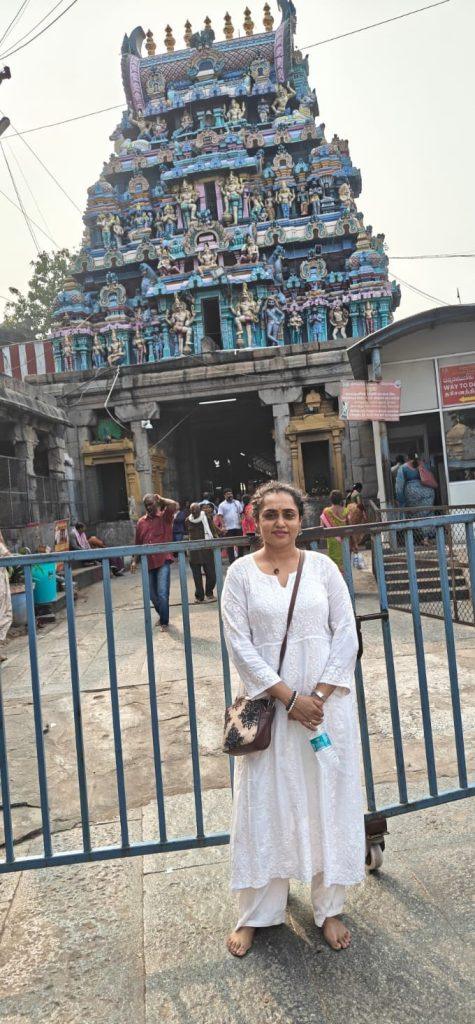
Now, I might be biased, being a South Indian, but the kind of bhakti (devotion) I feel in the temples down south, I haven’t felt anywhere else. The invisible energy that slowly wraps us, the temple bells, and the chants keep us grounded in the present while still connecting us with God.
After spending a good 2 hrs or so inside the temple, we were ready for our next destination – Kancheepuram, famously known as the “City of a Thousand Temples,” to meet Lord Shiva as Ekambareswarar (representing the earth element).
More about Kancheepuram in my next blog.
Traveling inward, wandering outward.
With travel stories that go deeper than what meets the eye
Priyaa


