
Hello beings of this beautiful planet. Thanks for stopping by!
One idea,
Few phone calls,
Some Google research and
Structured and mindful savings,
And I was all set for a trip to the south of India, to visit the Pancha Bhoota temples with my spiritual co-traveler and soul sister, Shivohie.
Before I get into sharing details about the trip, let me first share something about the in-between. About those moments of doubt, the ‘ifs’ and the ‘hows. Will the plan work out? What if the husband is traveling for work? Living in a nuclear family comes with its own set of challenges.
Thanks to my travel company (Bucketlist Travel Company), my kids are used to me traveling while leading groups, which, btw, feels like a story from a different lifetime. My worries were more of the peripherals. When do we women stop prioritizing ourselves? We hardly notice. I also had to think about managing my work, but the remote job offers the flexibility of traveling with my work table, installing it where and when required. I decided to take a leap of faith and chose to say yes when Shivohie came up with this idea.
As the adage goes, when you want something, all the universe conspires to help you to achieve it. Husband didn’t have travel plans, I was meant to be in Chennai for a family function, right before the Pancha Bhoota trip, Chennai being our starting point. I also learnt that it was the Margali Month (Margazhi), the ninth, sacred month in the Tamil calendar (mid-December to mid-January); considered highly auspicious for sadhana, bhajan, and pooja; holding a great spiritual significance. We took all of these happy signs as an encouragement from the Universe.
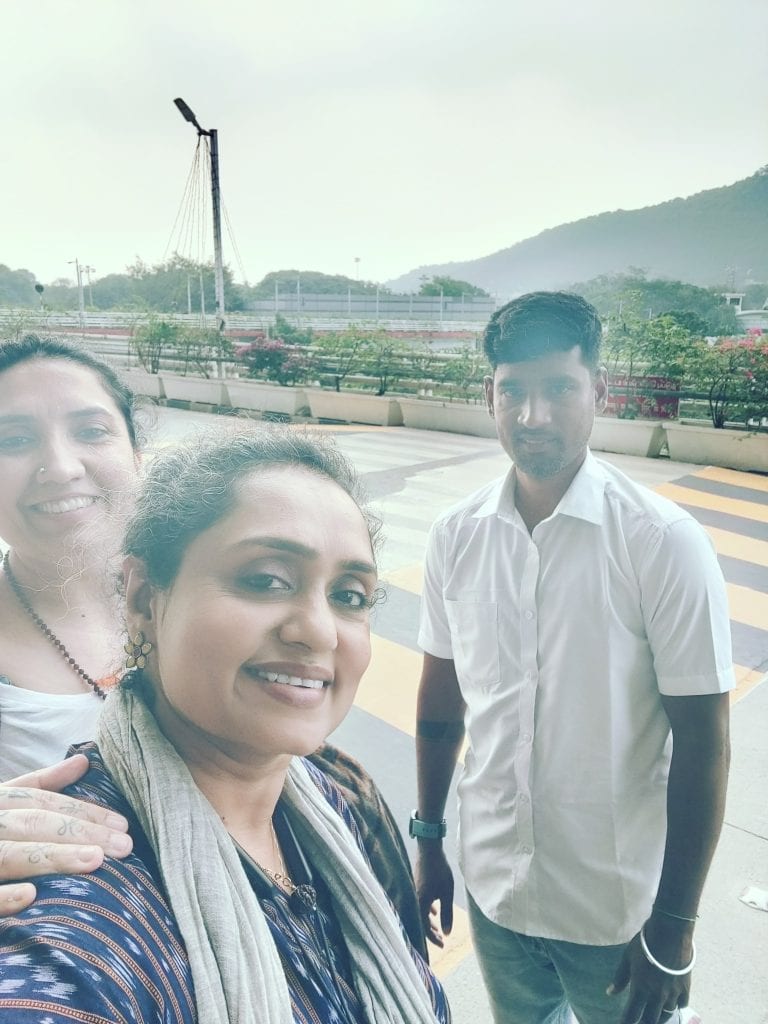
Icing on the cake, the driver who was assigned to take us on this spiritual voyage to all the Shiva temples was Nataraj (The dancing form of Shiva, the “king of dance,” symbolizing the cosmic cycle of creation and destruction)😊
The interconnectedness of all things never ceases to amaze me. Shivohie and I were all set for the cosmic dance (read the trip).
We were ready to go with the flow of the universe, meditate, go deep within, and commune with God. Liberate the old, outdated belief systems, create space for the new, inner continuous transformation through self-reflection, chanting, and meditation. I also chose to travel with my laptop, making the car, hotel room, cafes, etc., my office space.
Pancha (five) Bhoota (Elements).
Pancha Bhoota or Bhuta refers to the five fundamental elements in Hindu philosophy: Prithvi, Jala, Agni, Vayu, and Akasha (Earth, Water, Fire, Air, and Space, respectively), which form the basis of all creation, including the human body. These elements are central to cosmology, Ayurveda, and yoga, with specific ancient Shiva temples in South India (Pancha Bhoota Sthalams) embodying each element.
For those who have experienced Yoga or Ayurveda, would have come across mudras for various elements, one practice with the intention to balance these elements within themselves. Words like Vatta, Pitta, and Kapha in the AyurVedic science are nothing but references to the balance or imbalance of the elements in our body. Any physical ailment or psychological instability calls for looking into balancing these elements within us.
Chakras and Pancha Bhoota (five elements: Earth, Water, Fire, Air, Ether) are deeply interconnected in yogic and Ayurvedic traditions, with each chakra corresponding to a specific element, governing aspects of our physical and energetic being.
Briefly about the Five Elements (Pancha Bhootas)
- Prithvi, Earth: Our very existence. Mother Earth. Solid matter, structure. Mooladhara / Root Chakra. Symbolically represents stability and solidity. Our bones, teeth, tissues, etc., constitute the earth element in our body.
- Jala/Apas, Water: Liquids, fluidity. The blood, lymphatic system etc comes under Jala. Svadishthana / Sacral Chakra. Symbolically, water represents our emotions. We human beings are nearly 80% water, which essentially means all human beings are emotional beings. Researchers at the University of California, Berkeley identified 27 categories of emotion. Just imagine!
- Agni, Fire: Energy, transformation, heat. Our body temperature, digestion (digestive fire), all of this comes under the Fire element. Manipura / Solar Plexus chakra. Symbolically, representing our willpower or motivation to take action, our ability to digest not just food but life experiences.
- Vayu, Air: Movement, breath. Nerve impulses, circulation, and gases constitute the Air element in our body. Anahata / Heart Chakra. Symbolically, air represents our thought system. Overthinking or an absolute lack of mindful thinking leads to imbalanced Vata and a blocked heart chakra (difficulty in opening our hearts).
- Akasha, Space/Ether: The medium, void, or ether. The body cavities and the spaces with the cells in our body come under the Ether element. Visuddha / Throat Chakra, symbolising self-expression through mindful communication.
Ajna (third eye) and the Sahasrara (Crown) Chakra are the higher chakras linked to higher consciousness that help us transcend the elements and connect to all that is. The invincible. The ever-loving.
About the Pancha Bhoota Trip
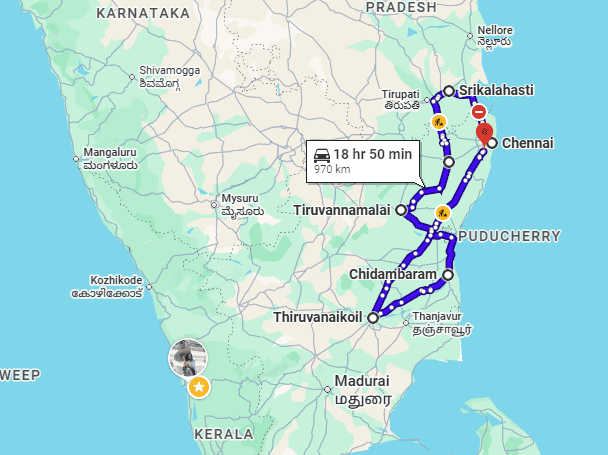
The elements are believed to have manifested in a specific order: first space, then air, fire, water, and finally earth. However, while traveling to the Pancha Bhoota temples, we chose to be travel practical. Logistically speaking.
Here’s how we progressed.
Pancha Bhoota Sthalams (Temples)
- Air (Vayu): Srikalahasteeswarar Temple (Srikalahasti, AP).
- Earth (Prithvi): Ekambareshwar Temple (Kanchipuram, TN).
- Fire (Agni): Arunachaleswarar Temple (Tiruvannamalai, TN).
- Space (Akasha): Thillai Nataraja Temple (Chidambaram, TN).
- Water (Jala): Jambukeswarar Temple (Tiruvanaikkaval, TN).
These five South Indian temples represent Lord Shiva as each element.
AP – Andhra Pradesh
TN – Tamil Nadu
Fun facts
- Three of these temples—Chidambaram (Ether), Kanchipuram (Earth), and Srikalahasti (Air)—stand on a single straight line along 79 degrees 41 minutes East longitude, despite having been built over 1,000 years ago without modern technology.
- The “Water Lingam” stays wet: At the Jambukeswarar Temple (Water element) in Thiruvanaikaval, the Shiva lingam (a symbolic representation of the deity) is said to be made of water worshipped by Goddess Parvati, and an underground water stream in the innermost sanctum ensures the area is always filled with water, despite efforts to pump it out.
- The Ekambareswarar Temple in Kanchipuram (Earth element) is home to a sacred mango tree believed to be more than 3,000 years old.
- The Thillai Nataraja Temple at Chidambaram represents the formless element of Ether/Space. Instead of a physical lingam, there is an empty sanctum sanctorum, signifying Shiva’s manifestation as emptiness or formlessness.
The intention I set, while we visited these temples, meditated, communed with the Shiva and Parvati energy…
“Please help me bring balance into my life. Balance of love and wisdom. Balanced receptivity and emissivity. Help me speak, help me be assertive like Maa Kali; however, keep it in my awareness that I am born as a girl / a woman, an embodiment of love and compassion. Emotional mastery through transcending fear and anger. Bless me with abundance in all quarters of life – Physical, Emotional, Intellectual, and Spiritual.”
Tall ask, one might say.
Why short sell, I say? 😊
You must have heard, “the crying baby gets the milk” OR “the squeaky wheel gets oiled”…so ask away. Parents know when to give and what to give to their child. They know what is good for the child. A parent will not give a 1st standard kid a Pythagoras equation to solve or give a hard candy to an infant, who might just choke on it!
So the supreme also knows. The parent of parents. Shiva and Shakti.
We are all children of God.
As Above, So Below.
So yeah, ask away, while using the time to work on oneself and become a better version of oneself, every day.
More about the trip, the itinerary, etc., in the next post.
Traveling inward, wandering outward.
With travel stories that go deeper than what meets the eye
Priyaa


